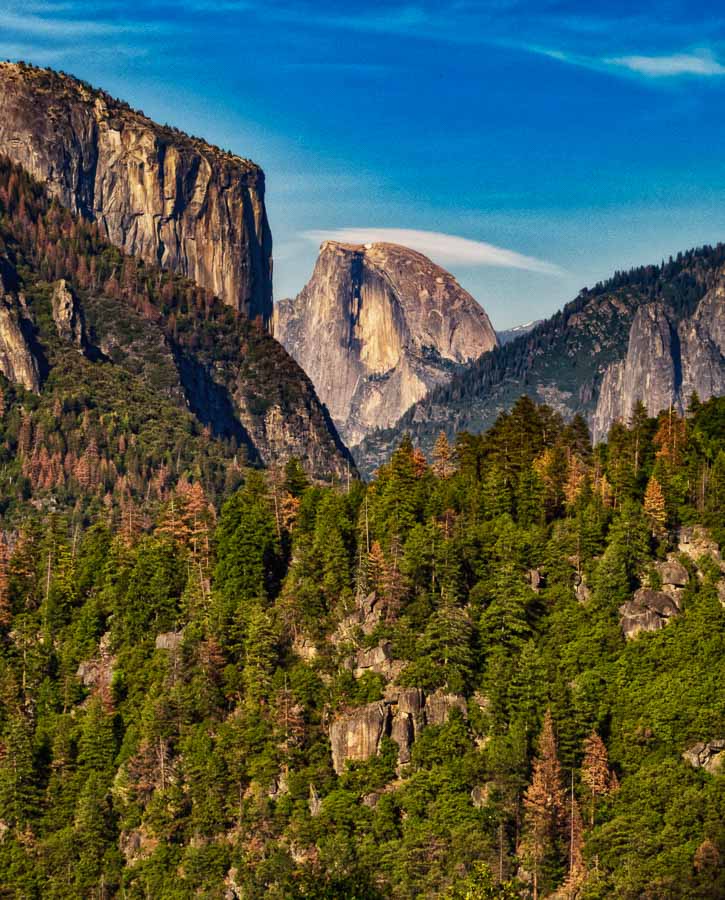
A Warm glow was settling over El Capitan and Half Dome as seen from Tunnel View.
We had stopped at Tunnel View prior to this, but the light was more inviting as we cam upon this scene at this time of day and we were compelled to stop once again. El Capitan can be seen in the upper left with Half Dome close to dead-center. It is awesome to see both major icons of Yosemite in this orientation.
Do you have a question about our visit to Yosemite? Ask it in the comment section.
JBRish.com originally published this post *All photographs Copyright by Jeffrey B. Ross with all rights reserved.
See previous Year of Yosemite (YOY) posts HERE. If you want to read the introduction to the YOY series, CLICK HERE.
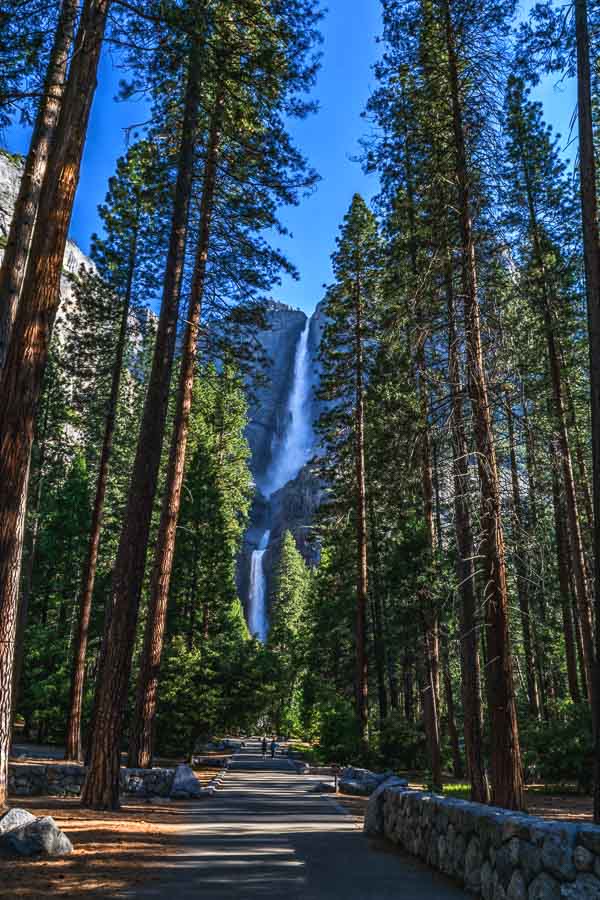
We started this day by walking to Lower Yosemite Falls
How wonderful is this? We started our day by walking to Lower Yosemite Falls to view this spectacular show of force and beauty. At our room nearby, we were able to hear the falls all day long. At night it lulled us to sleep!
“Yosemite Falls (2,425 ft)
Flows: approximately November through July, with peak flow in May.
Look for the ice cone at the base of the upper fall during winter and for roaring runoff April through June. Yosemite Falls, one of the world’s tallest, is actually made up of three separate falls: Upper Yosemite Fall (1,430 feet), the middle cascades (675 feet), and Lower Yosemite Fall (320 feet).
You can see Yosemite Falls from numerous places around Yosemite Valley, especially around Yosemite Village and Yosemite Valley Lodge (formerly Yosemite Lodge). A one-mile loop trail leads to the base of Lower Yosemite Fall (the eastern side of the loop, from the shuttle stop to the base of the waterfall, is wheelchair accessible).
It’s also possible to hike to the top of Yosemite Falls as a strenuous, all-day hike.” – (source)
NOTE – I looked at the webcam this morning (8/9/16) and I could not see any water flowing!
Do you have a question about our visit to Yosemite? Ask it in the comment section.
JBRish.com originally published this post *All photographs Copyright by Jeffrey B. Ross with all rights reserved.
See previous Year of Yosemite (YOY) posts HERE. If you want to read the introduction to the YOY series, CLICK HERE.
***********************************
Meta Data – Day 49 YOY – Year of Yosemite
File Name: 0126.NEF
Capture time: 7:44:44 AM
Capture date: June 5, 2016
Exposure: 1/15 sec @ f/16
Focal Length: 18mm
ISO 180
Nikon D3300
For those who are unfamiliar with the Sonoran Desert around North Phoenix, let me explain what happens during the heat of the summer through the middle of September.
The desert often creates strong dust storms and rain storms. These are customarily referred to as “monsoons” although technically they probably do not meet the necessary criteria for such a designation. Read more about our desert monsoons HERE!
During these storms, the Sonoran Desert receives much of its yearly rainfall. This past week, we had some very strong storms with winds and much rain.
When the “monsoon” storms arrive, there are desert plants that respond by soaking up the moisture and using the opportunity to bloom and produce seeds.
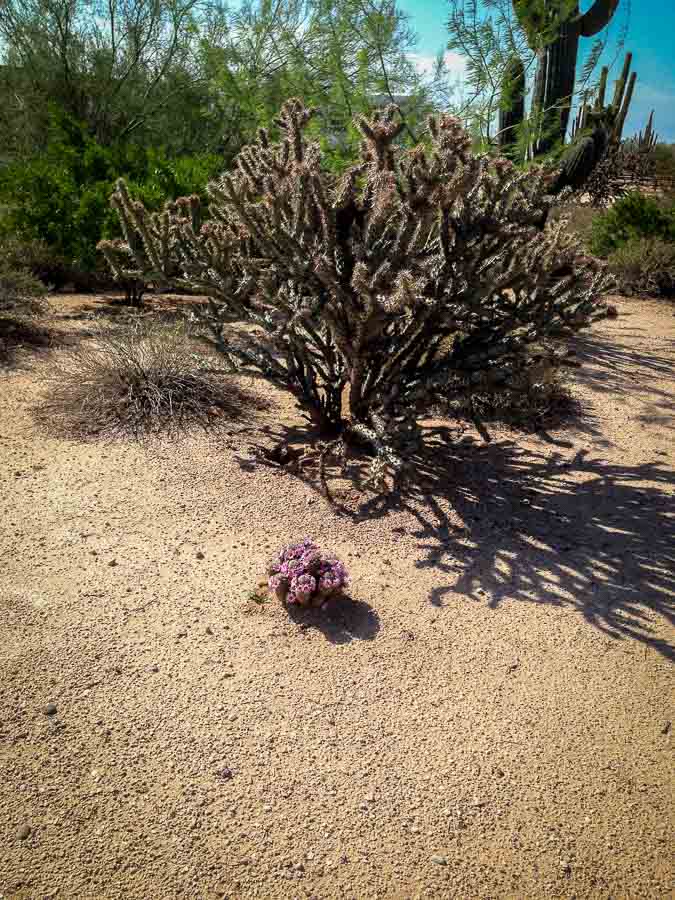
The picture below shows one such plant across the street from our house which is basically “the desert”.
Plants in the desert after the rain
The large plant in the center/top of the photograph that looks like it has antlers is a cholla. This is one plant that people try to avoid because it is segmented with a multitude of needles. The needles grab on to clothing, skin, leather or almost anything and a segment then breaks off and goes for a ride with the bearer. This is one way the cholla propagates.
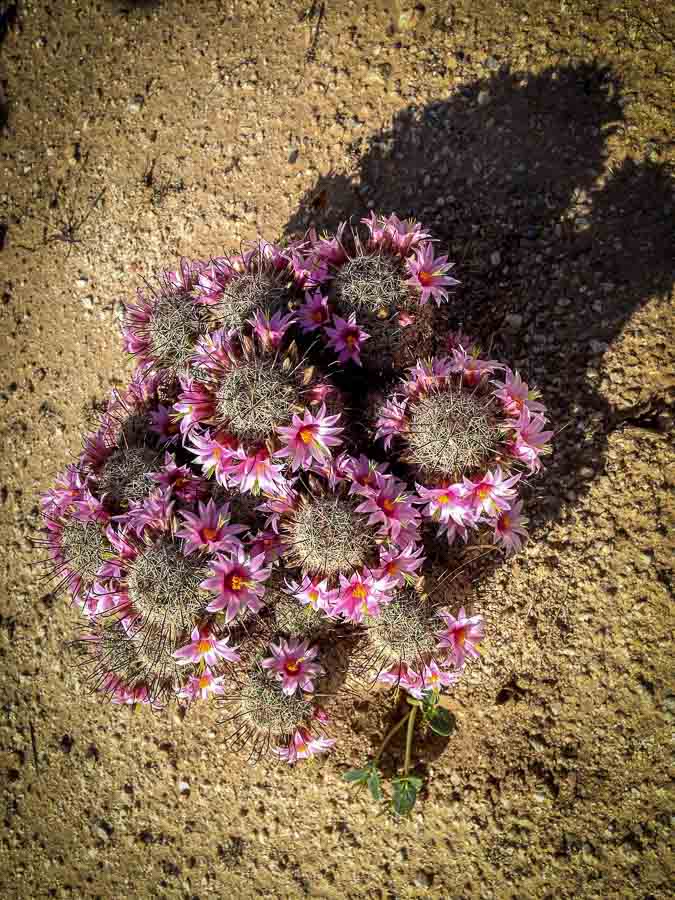
In front of that large pant is a smaller cluster of cacti. This is a mammillaria and it produces a variety of pinkish flowers that nearly look artificial. They are very attractive and seem as if they would be at home in a tropical drink at the local brew pub.
Here is a closer look…
This mammailaria cluster has dozens of flowers which create a colorful bouquet
This is a non-cultivated plant that grew on its own. We do enjoy having it in our neighborhood!
We have had several cats as pets and anyone who has had a relationship with a cat can tell you that there is definitely a type of “yin and yang” to that relationship. Most cats, and this included ours, are fairly aloof although they do like attention when they want it and on their terms.
Cats can be very funny as they show tremendous courage on one hand and can be afraid of their shadow on the other. We do find them to be lovable as long as one can accept their distant character. (This is a generalization and of course there are exceptions!)
The video below shows members of the Italian Coast Guard resuscitating a kitten that was in danger of drowning. While it looks more like a wet rat during the recovery phase, the other pictures show how cute it is.
These coast guardsmen should be commended for showing such humanity in giving a high level of importance to this relatively incidental life when compared to the human trauma they see on a daily basis. This is one lucky kitten!
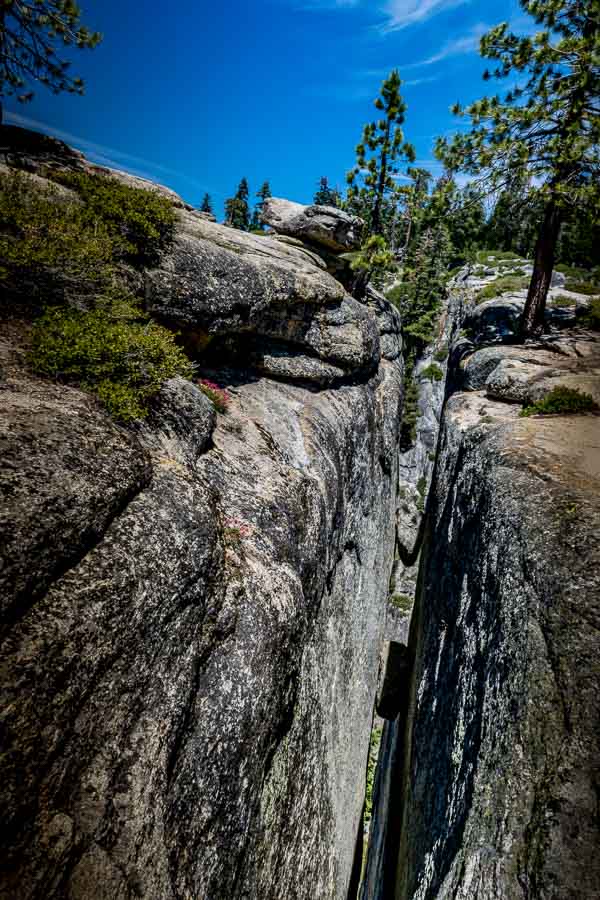
I must confess that it is difficult to portray this physical phenomenon in a two dimensional picture, put fissures are large crevices (or cracks) in rocks. They can be very dangerous as they often intersect areas close to trails and form a hazard for hikers.
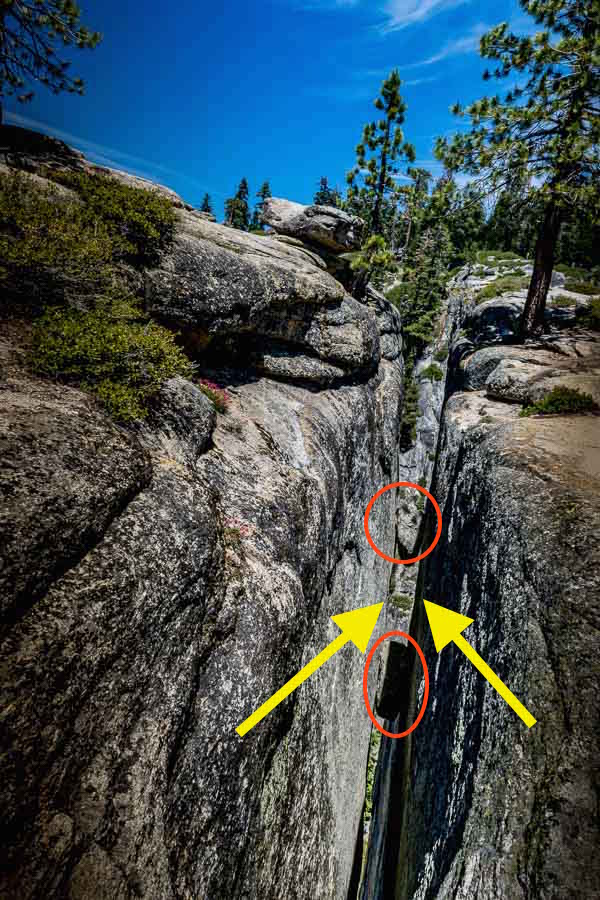
Naturally hikers need to be vigilant at all times, but when hiking with children, one needs to be doubly aware. Can you see the large crevice with the two small boulders that have fallen in the crack? That could be a person wedged in there. To make matters worse, some areas near the edge of the fissures have small shrubs along the perimieter which might camouflage them a bit.
Of course there are warning signs alerting hikers of the dangerous fissures and to alert families to hold children close.
NOTE – If you haven’t discerned the fissure, look at the picture below. The arrows point to the walls of the fissure and the red-orange ovals show the boulders that are wedged in the crack.
Do you have a question about our visit to Yosemite? Ask it in the comment section.
JBRish.com originally published this post *All photographs Copyright by Jeffrey B. Ross with all rights reserved.
See previous Year of Yosemite (YOY) posts HERE. If you want to read the introduction to the YOY series, CLICK HERE.
“The art of living is more like wrestling than dancing.” — Marcus Aurelius
“The simplest schoolboy is now familiar with truths for which Archimedes would have given his life.” — Ernest Renan
“Every man has in himself a continent of undiscovered character. Happy is he who acts as the Columbus to his own soul.” — Sir J. Stephen
“When you are younger you get blamed for crimes you never committed and when you’re older you begin to get credit for virtues you never possessed. It evens itself out.” — Casey Stengel