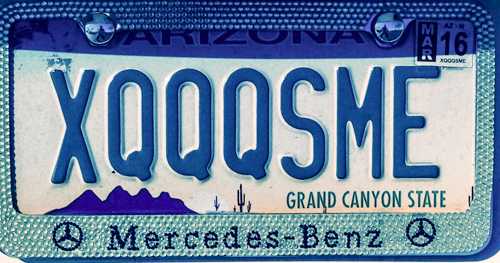
PL8ATUDES – March 24, 2015


Plate-A-Tude

We continue our series of personalized (vanity) license plates in Arizona. To maintain individual privacy, we try to show as little information about particular cars as possible as long as we can reveal the license plate.

NOTE – License plate photos may have been archived for quite some time. The years indicated on the registration stickers DO NOT necessarily reflect the current status of any given plate!

We hope you enjoy these PL8ATUDES!

****************************************

I’m A

Sore Loser


So…

Excuse Me

!

.JBRish.com originally published this post

——————

STATUS QUOtes — 20150324 — Plus a Factoid

“Life is really simple, but we insist on making it complicated.” — Confucius

“Don’t be distracted by criticism. Remember…the only taste of success some people have is when they take a bite out of you.” — Zig Ziglar

“Ubiquitous doesn’t mean forever, and popular isn’t permanent. Someone is going to fade, and someone is going to be next to take their place.” — Seth Godin

“There is no thief like a bad book.” — Italian proverb


Factoid — “Lots of people think, well, we’re humans; we’re the most intelligent and accomplished species; we’re in charge. Bacteria may have a different outlook: more bacteria live and work in one linear centimeter of your lower colon than all the humans who have ever lived. That’s what’s going on in your digestive tract right now. Are we in charge, or are we simply hosts for bacteria? It all depends on your outlook.” – Neil DeGrasse Tyson

Pickleball…honestly

Last week we had friends visiting from other towns and other states. One common denominator among several of the men was a keen interest in Pickleball so naturally off to the courts we went.

We had a great afternoon of play. We played together for several games, changing up sides, etc. and then we played with others to get a variety of experiences.

A day or two later, a discussion arose regarding line calling (in or out) and cheating and I said: “What is the sense of cheating?” It seemed only logical to me that to win at a game that one had to cheat in would be a hollow victory indeed. My companions explained that they had witnessed people cheating about line calls in order to gain an advantage.

I must say, and perhaps I am naive, but I have not been aware of this behavior in my one-year experience. We were not discussing close calls or “honest mistakes” where one of the players actually perceived that the ball was “out” and called it that way.

I have developed a personal set of rules FOR NON TOURNAMENT AND CASUAL PLAY, that I understand pretty much coincides with the rules of most other players.

1 – If a ball is close to a line and I cannot make a definitive call, the call goes to the other team.

2 – I never argue a call that is on the end line of the opposite end of the court. I am not close enough usually to get a very clear view, the net is often blocking my line if sight and I accept their word as the correct call. Conversely, I don’t expect them to challenge my calls at my own end line either (see #6 below for a corollary).

3 – If a ball is too close to call on my own end line (hit be the opposing team), I continue to play it as though it is good. The other team gets the benefit of the doubt!

4 – I self-call kitchen zone infractions as I anticipate the other team will do the same.

5 – ANYTIME a ball from another court enters the established playing zone of a court on which I am playing, it is to be called and the current point stops and is re-played. This is an important safety rule and ALL balls should be called to eliminate the need to make a decision whether or not a ball is close enough to the play, etc. [ BTW – If am the server, I call the point score and say “serve over.” What do you do in the above situation? ]

6 – If I make a call and another player challenges it, I query the remaining players. If another player sees it one way or the other, then that is how the call is made. If the questioning player says they are “sure,” then I let the call go their way. It is only a point and if one point makes that much difference, then they deserve to have it. [If this happens often, then my attitude would become a bit different, but it hasn’t happened frequently thus far.]

7. – If playing indoors or at close quarters outside (not in tournament play) if a ball is obviously going to be out and the opposing player catches it to save the ball from bouncing errantly, this is fine with me. Most of the time I do let the ball bounce and then catch it, but if I see it is going to head over to disrupt another court, I sometimes will catch it in the air to prevent a stoppage for the other players.

Are there any experiences you have had with Pickleball and line calls or rules that you would like to share? Are there any situations not mentioned above that have important guidelines for “most players?”


STATUS QUOtes — 20150323

“The soul is the voice of the body’s interests.” — George Santayana

“If you haven’t forgiven yourself something, how can you forgive others?” — Dolores Huerta

“No partner in a love relationship… should feel that he has to give up an essential part of himself to make it viable.” — May Sarton

“I once absent-mindedly ordered Three Mile Island dressing in a restaurant and, with great presence of mind, they brought Thousand Island Dressing and a bottle of chili sauce.” — Terry Pratchett

Photography: Strangers in my Shoebox

We have had a number of out-of-town visitors so my posts this week have been somewhat abbreviated. Yesterday, however, I created an entry called “Why Photographers Do What They Do”, which links to a video about possible motivating and inspiring forces behind photography.

As citizens of a highly visual world, we might often overlook the importance of photographs in our lives and why many of us have shoe boxes, or the equivalent, of old photographs stored on a shelf somewhere in our home. I know that I have pictures of people that I must acknowledge remain strangers to me. They might have been important to my parents or grandparents, but are foreigners in my household and yet lie in repose firmly stacked among my closest of relatives.

Some of these pictures are only reviewed every few years or once a decade. The point is that they are looked at. Maybe a death in the family prompts the cobwebs to be wiped away. Why do we keep these photographs? Why are there dozens or hundreds of pictures that are only looked at periodically?

Missy Mwac might have the answer to the questions above in her revealing and poignant piece, “If You Don’t Think Photos Are Important, Wait Until They Are All You Have Left.” I encourage you to read her essay to find out why, we as consumers of visual media, do what we do.

What do you think about Missy’s essay and the thoughts above?

STATUS QUOtes — 20150322

“One cannot look at the sea without wishing for the wings of a swallow.” — Richard Francis Burton

“Once you have read a book you care about, some part of it is always with you.” — Louis L’Amour, Matagorda/The First Fast Draw

“Words can sting like anything, but silence breaks the heart.” — Phyllis McGinley

“Any society that needs disclaimers has too many lawyers.” — Erik Pepke

Why Photographers Do What They Do

This video, The Calling, explains why David McLain is willing to put his life in the hands of strangers, leave his family for long periods of time and visit far away places to create photographic or motion images. This is what all photography is about whether you are an enthusiastic hobbyist, casual point-and-shooter or professional photographer. Creating the image of that unique moment is the reward.

Watch this beautiful and inspirational movie:

The Calling from SonyElectronics on Vimeo.

STATUS QUOtes — 20150321

“Fatigue is the best pillow.” — Benjamin Franklin

“All things splendid have been achieved by those who dared believe that something inside them was superior to circumstance.” — Bruce Barton

“Every creator painfully experiences the chasm between his inner vision and its ultimate expression.” — Isaac Bashevis Singer

“We can defeat gravity, but sometimes the paperwork is overwhelming. [ed]” — Wernher von Braun